|
|
|
As mentioned regarding Orion, Gaia may have sent the scorpion to kill the mighty hunter, as he had vowed to rid the earth of all wild animals. Or Apollo might have told Gaia of Orion's boast, fearful that Orion had designs on Apollo's sister Artemis.
In any case it was Gaia who sent the scorpion to kill Orion. Later the
animal would chase Orion across the heavens, but it could never catch
him, for the scorpion was so placed that it would rise in the east only
after Orion had safely disappeared over the western horizon.
Scorpius is one of the oldest constellations
known - possibly even one of the original six signs of the zodiac.
While the sun still traverses Scorpius, it only takes nine days to do
so; most of the time is spent in neighbouring Ophiuchus (which is the
only constellation that the sun enters but which is not a part of the
zodiac).
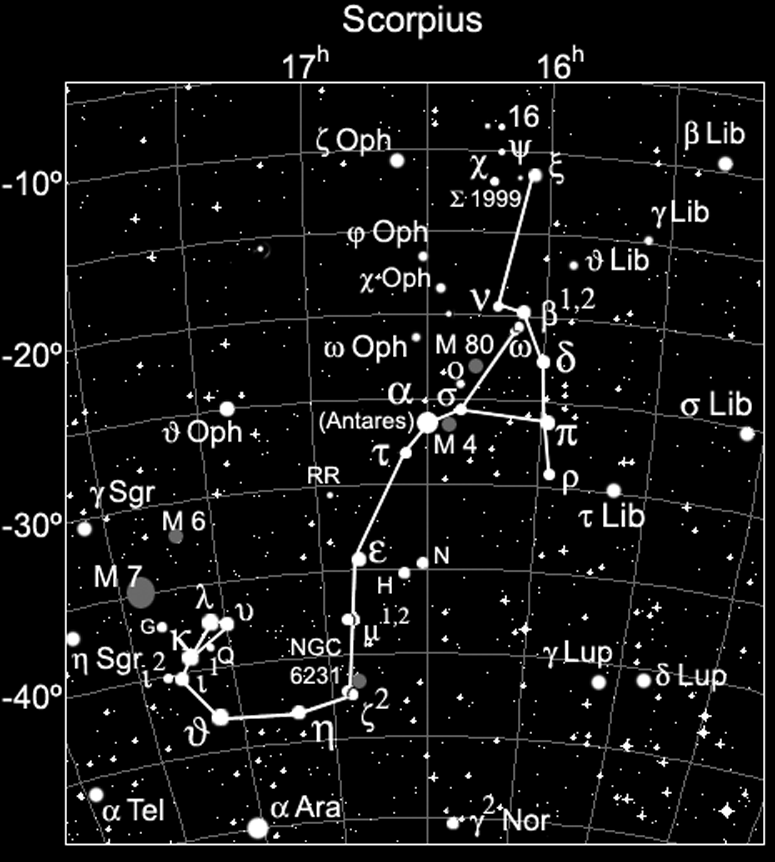
The asterism of a gigantic skewed "S" was seen in many ancient cultures as a scorpion, possibly handed down by cultural conquest or influence. The two stars lambda and upsilon, both called "The Sting" in Arabic, traditionally form the stinger, although some star maps currently show the nearby "G Scorpii" as one of the stingers. We have recently changed our graphic to reflect the original stingers.
The constellation was once much larger, but the western portion representing the claws of the scorpion was given to Libra.
The star table indicates just how bright many of Scorpius's stars are; in fact the constellation is one of the brightest of the larger constellations.
Alpha Scorpii is better known as Antares ("Rival of
Mars"). This is one of the four Royal Stars of the ancients, along with
Aldebaran, Regulus, and Fomalhaut. It glitters with an unusual metallic red while the entire region is bathed in a pale red nebula, lit from the same star.
Due west 1º (about half the distance to sigma Sco) is the
bright globular cluster M4, while another globular cluster, M80, is
4º NNW of Antares. See below for these deep sky objects.
[NOTE: See the Binocular Section link at the bottom for updated values.]
Alpha Scorpii is a visual binary which may be difficult to resolve due
to the brightness of the primary. Try a moonlight night, which should cut
the glare of the brighter star: 1.1, 5.4; PA 274º, separation 2.6".
Beta Scorpii. This superb double has a pleasant colour contrast:
white and bluish-green. 2.6, 4.9; PA 23º, 13.7".
Nu Scorpii is a multiple system, a "double-double". That is, each
of the visible components (AC) is also a primary of a closer component;
these are termed AB and CD.
Xi Scorpii is also a multiple system, a system which also includes
the next binary system as well (Struve 1999).
Sigma Scorpii: a double with faint companion. AB: 2.9, 8.5; PA
273º, separation 20".
Struve 1999 is gravitationally attached to the Xi Scorpii
system, although at a distance of about 7000 AU (an "AU"--astronomical unit-- being the distance of the earth from the sun).
RR Scorpii is the brightest long-period variable in the constellation,
with a visual magnitude range of 5.0-12.4 every 281.45 days. In 1999
the maximum should occur around the end of May.
There are four Messier objects in Scorpius (some authorities put a fifth
in the constellation as well: M62, but usually it is listed in
Ophiuchus).
M6 (NGC 6405) is the second-best cluster of the constellation
(after M7). This is an open cluster which sometimes bears the name "The
Butterfly Cluster". Its brightest star is BM Scorpii, a sixth-magnitude
yellow giant. The cluster is about 1500-2000 light years away.
M7 (NGC 6475) has no name, but is clearly the best deep sky object
of the constellation. This magnificent open cluster is extremely large
(two full-moon diameters) and quite bright, being visible even to the
naked eye under the right conditions.
M7 is 4º NNE of lambda Scorpii. It's about 800 light years away.
M80 (NGC 6093) is a rather faint, very compact, globular cluster in
the vicinity of Antares, between this star and beta Scorpii, and more
narrowly speaking, nearly midpoint between two 8th-magnitude stars (which
are the brightest stars of the region). The cluster is quite distant,
some 36,000 light years away, and it takes a very large telescope to
study it in detail.
NGC 6231 is a naked-eye open cluster one half degree north of zeta
Scorpii (which is in fact a member of the group). This cluster is certainly
worthy of being a Messier; while noticeable to the naked eye, binoculars
resolve its various members. It's about 5500-6000 light years from us.
The cluster is only part of a much larger, very scattered, cluster called
H 12, which is found one degree north. In fact, the stars seen as
joining NGC 6231 and H 12 actually form one of the spiral arms of our
own galaxy.
For a more detailed appreciation of Scorpius visit the Binocular Section.
Or go to
the Main Menu
|