|
|
|
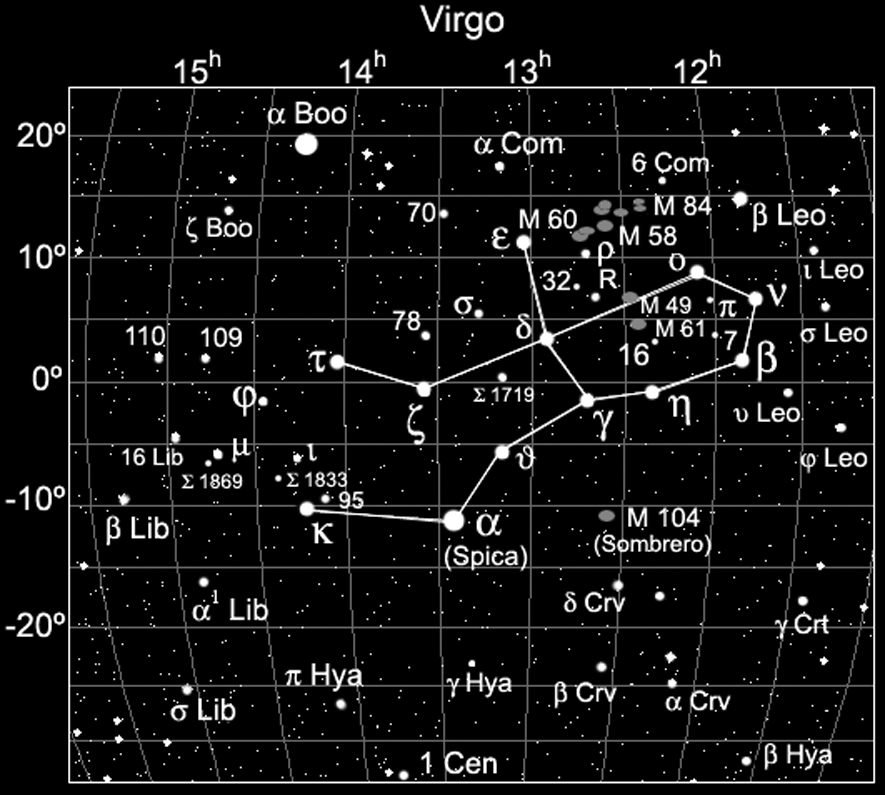
Virgo is the second largest constellation (after Hydra). As a member of the Zodiac, Virgo has a number of ancient myths and tales. The Sun passes through Virgo in mid-September, and is therefore the constellation that announces the harvest.
Virgo is often represented as a "maiden" (as its name indicates). In
antiquity, she may have been Isis, the Egyptian protectress of the
living and the dead and the principal mother goddess.
She was also Ishtar of the Sumerian-Chaldean civilisations, or "Inanna",
meaning Queen of Heaven. Inanna is described by Kramer (The Sumerians)
as an ambitious, aggressive, and demanding goddess of love.
In Roman times the goddess Ceres was depicted: the goddess of the growth
of food plants and harvests, and particularly corn. Her festival was in
the second week of April, the same time that the constellation appears
in the Spring skies.
The Romans had simply adopted an earlier Greek goddess, Demeter. This
goddess of agriculture was of the highest birth: born to Cronus and
Rhea, she was the sister of Zeus. As evidence of her antiquity in Greek
lore, her name has been found on a tablet from Pylos dating to the
thirteenth century B.C.
The goddess was depicted then, as now, as carrying a sheaf of wheat. But
her influence carried not only to cereal crops, but to all kinds of food
crops. Not surprisingly, perhaps, she was also the goddess of health,
and of births and marriages.
A ceremony held in her honour in ancient Greece was called
Proarktouria, which possibly indicates that the festivities were
held just before the rising of Arcturus. However the name may instead
make reference to the constellation Virgo, which in fact rises just
before the star Arcturus.
Gamma Virginis carries the name of the Roman goddess of prophecy:
Porrima.
[NOTE: See the Binocular link at the bottom of this page for updated data.]
Theta Virginis is a white star with two companions, both rather
faint: AB: 4.4, 9.4; PA 343, separation 7.1"; AC: 4.4, 10.4; PA 298º,
separation 70".
Phi Virginis is a fixed binary: 4.8, 9.3; PA 110º,
separation 4.8". The primary is a delicate yellow.
Struve 1719 is a striking binary of nearly equal stars: 7.3, 7.8;
PA 1º, separation 7.5".
A number of stars show very slight variability, such as alpha
Virginis, an "Ell." type variable: 0.95 to 1.05 ever four days and
rho Virginis is a delta Scuti variable: 4.86-4.88.
R Virginis is a long-period variable with a range from 6.2 to 12.1
every 145.63 days, exceptionally short for a Mira type variable. In 2000
the maximum should occur in the first week of June.
Virgo has some exceptional deep sky objects: the Virgo Galaxy Cluster,
which contains eleven Messier Objects, more than any other constellation
except Sagittarius (which has 15). There are also many fine NGC objects
in the same vicinity, some just as splendid as the Messiers (such as
NGC 5364 and the Siamese Twins: NGC 4567 and 4568).
Then there is the quasar 3 C 273, thought to be from two to three
billion light years away.
The region from Coma Berenices down through Virgo is renowned for its galaxies:
the Virgo Galaxy Cluster, considered to be about 42 million light years distant.
In the midst of dozens of bright galaxies are eleven chosen by Messier for
his catalogue.
It is impossible to is give specific directions to locate each Messier
object in an extremely rich field. Burnham (p. 2075) gives a useful grid to
assist in their location, and recommends at least a six inch telescope.
You may find that an even larger scope is necessary to get the most out
of this region.
M58: bright compact barred spiral, but it takes a good night and
at least a medium sized telescope to see the central bar.
M61: armed spiral seen face-on, very bright. This is one of the
largest galaxies associated with the Virgo Cluster, and may have a mass
of fifty billion Suns. Three supernovae have occurred in M61, the last
in 1964.
M84, M86, and M87: three more ellipticals, in a very rich region.
M87 is the centre of the Virgo Cluster, and is one of the most luminous
galaxies known.
M89: small elliptical, resembling M87 but fainter.
M90: nice spiral in same region as M89.
M104: The Sombrero Galaxy. Truly magnificent, this galaxy is isolated
from the rest (although apparently is still a member of the Virgo Cluster).
It was this object in Virgo, 3 C 273, that was first identified as
a non-stellar object, by Maarten Schmidt, from the analysis of its redshift.
Quasars are perhaps the most luminous object known; some (including 3 C
273) are known to have absolute magnitudes as great as -27.
Burnham (p. 2101) gives an identification chart, as well as a detailed
discussion on the phenomenon of quasars.
For a closer look at Virgo visit the Binocular Section.
Or go to
the Main Menu
|